Who am I?

Geometry determines arithmetic.

— M. Hindry and J. Silverman

I'm Edgar Delgado Vega, a musician from Lima, Peru, who develops software to explore how ideas move between mathematics, computation, and music.

I often start with a mathematical or musical idea and wonder what happens when I carry its structure into another domain.

Code should be seen as well as heard, underlying algorithms viewed as well as their visual outcome.
— TOPLAP Manifesto
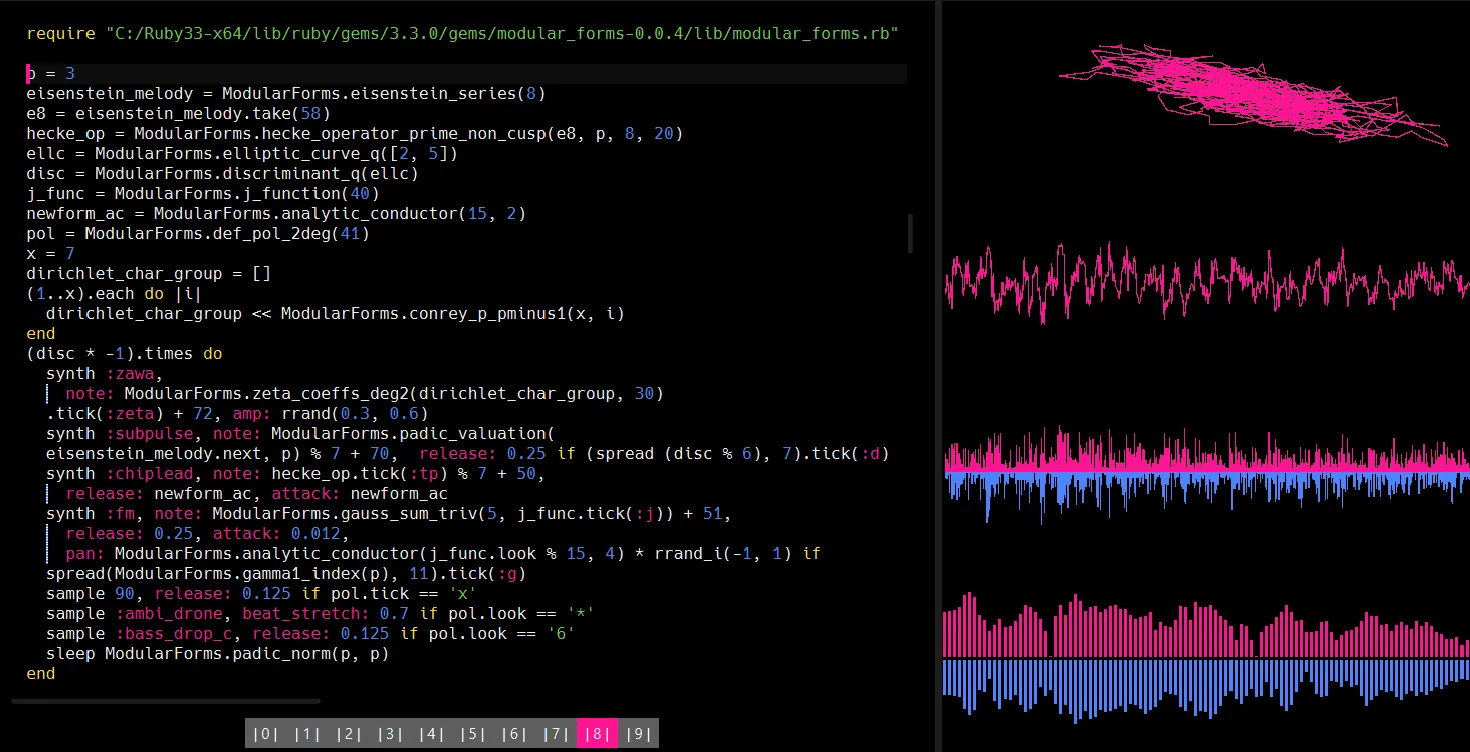
Picture of modular forms library on Sonic Pi
Modular Forms and Elliptic Curves for Sonic Pi

As someone who enjoys questioning things, I prefer to reconstruct algorithms and ideas from music theory with enough mathematical rigor to bring patterns to light. This process also involves considering asymmetries and non-commutativity, and I find that such a systematic approach can lead to new concepts.

Precise knowledge of the behavior of an analytic function in the neighborhood of its singular points is a source of number-theoretic theorems.
— E. Hecke
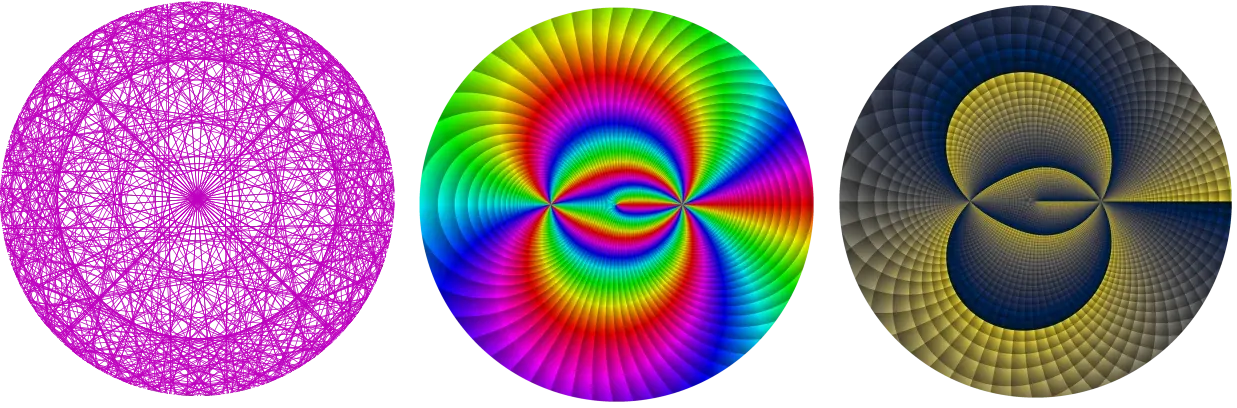
Picture of 5D Hyperoctahedron (Discrete and Continuous)
5D Figurate Number Hyperoctahedron: discrete pattern in Z/nZ\mathbb{Z}/n\mathbb{Z} (left) versus continuous meromorphic representations in C\mathbb{C} (center and right)

Interests

I work with structures from number theory as a basis for computer-assisted music composition. In my early work, I was oriented toward explanatory theory, but I soon shifted to exploratory models, in which my interest focused on formal systems rather than their correspondence with canonical musical practice.

  • Mathematical Music Theory
  • Modular forms, elliptic curves, and figurate numbers

Teaching Experience

I have teaching experience at both undergraduate and postgraduate levels, particularly in live coding and musicology with a technological focus. See my teaching feedback.

I've tried to learn the hidden beauty in various things, but still for many areas the source of interest is for me a complete mystery. My theory is that too often people project their human weaknesses/properties onto their mathematical activity. There are obvious examples on the surface: for example, the idea of a classification of some objects is an incarnation of collector instincts, the search for maximal values is another form of greed, computability/decidability comes from the desire of a total control.
Fascination with iterations is similar to the hypnotism of rhythmic music.

— Maxim Kontsevich
Technologies
  • TypeScript, Node.js, Express, SQL, Git

  • Some knowledge of Ruby and Python

  • LaTex, GeoGebra, Zotero, BibTex

  • Sonic Pi, MuseScore, Reaper

Education

UNIR · Master's Degree in Music Research

2019–2020 · Spain

I received the highest distinction with a perfect score in Computational Music Analysis. Overall average: Outstanding. · TFM: I applied the theory of simplicial complexes (MaMuTh) to analyze a musical style using specialized software. 💻 HexaChord, Geogebra, LaTex

USMP · B.A. in Music

2009–2015 · Peru
© 2026 Edgar Delgado Vega