Towards Gamma Functions for Figurate Numbers
Recently, I was reviewing how to extend the greatest common divisor function for two integers, because I wanted to imagine associating a kind of rays emerging from the points of a geometric object.
In this regard, being a bit verbose, if and are prime factorizations of , then:
If , then and are comprime. However, points on varieties are also defined over , as well as over , , including number fields.
Therefore, I had a searching question:
Does there already exist a function , with connections to the arithmetic and geometric world, that has extended its domain from to , or even beyond?
Prelude to the Nap of Euler
I found that for certain types of domains, called Unique Factorization Domains (UFDs), there is an analogous notion with some subtleties. For example, the rings of integers and (for certain values of ) are UFDs where behaves similarly to the classical case.
But, I didn’t want to enter the terrain of ideals and abstract techniques of algebraic number theory. I really needed to go step by step. In , I found that there exists a trick using to define something like a , but it didn’t convince me, because it’s particular to this context. And what about ?
I also realized that the issue in the reals, and in every field, is that the notion of becomes trivial from an algebraic standpoint. Since every non-zero element is invertible, every element divides every other, making the concept vacuous.
So, because it’s good to revisit techniques and ideas from even earlier times, I remembered, of course, that Euler, a few centuries ago, had already carried out this process in a phenomenal way with another arithmetic ubiquitous function.
Triangular Numbers are The Prototype
For me, a practical, though not complete, way of seeing figurate numbers is that they are a mixture of arithmetic and geometry. That is, it is a representation of numbers as points in the plane, space, or space creating a figure.
The main question to be raised in this post comes in two steps from what is presented in the engaging article by Philip J. Davis. The first step occurs on page 850, where he explains that interpolating the formula for the -th triangular number with rationals is practically natural and remains well-defined.
For now, my library figuratenum only allows you to do the following to generate integers .
from figuratenum import PlaneFigurateNum as fgn
# Generate triangular numbers
gen = fgn().triangular()
triangular_num = [next(gen) for _ in range(100)]
# [1, 3, 6, 10, 15, 21, 28, 36, 45, 55, 66, 78, ...]
The type hints for the generators I’ve made int, for the moment, so it will throw an error if you enter a float in range().
Finally, on the next page 851, he warns about the crux of this question. If we substitute the additive operation in the expansion of with the multiplicative one, we obtain nothing other than the factorial function commonly denoted
But, how to put the factorial in a continuous line?
Recharge On The Gamma Function
Again, as with many great identities and formulas, the answer lies in the Gamma function, one of my favorite functions in all of mathematics. Although in another post on my blog and in my ideas I deal with the modern integral version in the complex plane, here I invoke the second Eulerian Integral (according to Legendre):
As Philip J. Davis mentions, it was a matter of interpolation that invoked Euler’s mind to define the factorial function this way. But, although it is a simple integral to visualize, this was not as easy to deduce as it can be done for triangular numbers.
The Dual Question
I’ll go straight to posing the analogy here, along with the diagram:
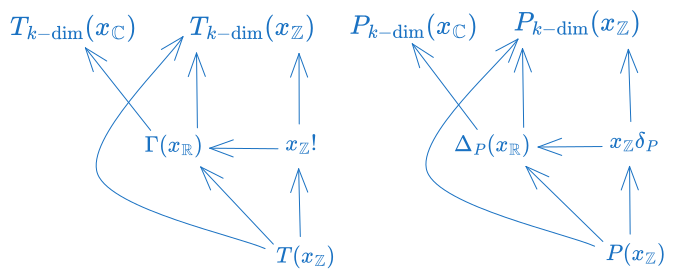
Towards a New Class of Gamma Functions for Figurate Numbers
Let’s think of the figure in two components. Let’s start with what we already have some grounding for: the left side. First, we observe that several operations occur simultaneously towards more general instances. The first is a transfer of notion by substitution: they are triangular figures, then it’s factorial.
The allows for the definition of the multidimensional triangular numbers, also called the -hypertetrahedron, denoted as . This is defined through a recursive formula and an alternative definition using the rising factorial, as discussed in the book Figurate Numbers (2012) (another alternative involves the binomial coefficient)
On the other hand, the detour with an arrow pointing to is extremely important, because it is a transfer towards a broader domain by interpolation, and allows restriction to the integer version and to a possible complex version of the hypertetrahedron.
For instance, here’s how you generate a 120-dimensional hypertetrahedron in figuratenum:
from figuratenum import MultidimensionalFigurateNum as fgn

gen = fgn().k_dimensional_hypertetrahedron(120)
k_100_hypertetrahedron_num = [next(gen) for _ in range(100)]
# [1, 121, 7381, 302621, 9381251, 234531275, 4925156775,
# 89356415775, 1429702652400, 20492404684400, 266401260897200,
# 3172596834321200, 34898565177533200, 357039166816301200,...]
But the good part comes here: in the right component of the figure, is a polygonal number or any figurate number in the plane. The is its corresponding multidimensional version. Let’s remember that there are many figurate numbers that don’t have a multidimensional counterpart.
The and functions are the analogues of the Gamma function (by interpolation) and factorial function by operation substitution that correspond to each type of figurate number .
Well, after so many twists and turns, the naive question I arrive at goes like this:
Does there exist a function analogous to by substitution and interpolation for each type of figurate number that can define similar multidimensional geometric objects over UFDs, complex numbers, or in a number field ?
I would expect such a to inherit beautiful properties, like convexity, perhaps log-convexity, or functional recurrence relations.
But whether these properties hold in general, or need tailoring to specific , well, that’s part of the puzzle. Maybe they fit together like pieces of a larger mosaic with other special arithmetic functions already known to us. Could be a rewarding exploration for anyone curious enough to dig in.